Christopher Nolan’s uncomplicated The Odyssey
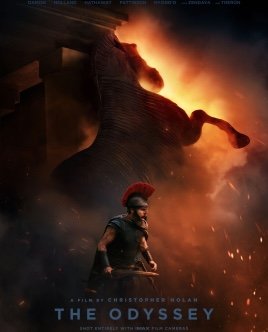
I fully expected to love Christopher Nolan’s The Odyssey. But on viewing the film, I was struck by its technical achievements, its visual beauty and grandeur, but felt emotionally and intellectually underwhelmed.
This may be because I’ve been immersed in Ancient Greece for over a year. That culture can be described by the adjective Homer uses in the first line of the poem to describe Odysseus himself: πολύτροπον.
This term has plagued translators for centuries and has been called variously “of many ways,” “of many devices,” “of twists and turns,” “wily.” Emily Wilson—understanding in her modern translation that it’s impossible for one word to describe Odysseus’s many contradictory facets—simply uses “complicated.”
Nolan shields his audience from this complexity by recounting the story in a distinctly American register. Telemachus calls Odysseus “dad.” Jon Bernthal plays the swaggering Menelaus as if he were Mikey in “The Bear.”
And Nolan’s Odysseus is no longer Homer’s charmingly entertaining rogue—the huckster who, when not screwing his way across the wine-dark sea or grandstanding his way out of danger, occasionally longs for his wife, Penelope.
Instead, he’s a battle-scarred veteran, suffering from PTSD, haunted by guilt over his use of the Trojan Horse. Nolan’s Odysseus sees his celebrated tactical maneuver as a violation of xenia—an ancient Greek prescription to do to others what you would have them do to you—a deceit that unleashed slaughter and destruction upon Troy.
Homer this is not. One of Homer’s epithets for Odysseus is πτολίπορθος, “sacker of cities.” The obligations of xenia did not extend to men at war.
Creating an Odysseus that appeals to a modern audience is a perfectly reasonable artistic and commercial choice. Contemporary viewers are unlikely to sympathize with the Bronze Age economy based on rape and pillage, or the concept of kleos aphthiton—imperishable glory through victory in man-on-man combat.
So the question one must ask is whether the film succeeds on its own grounds. It does, but in a way that seems much less interesting than the original.
Matt Damon’s restrained performance flattens a character whose contradictions and vitality are central to the original epic.
The screenplay as well irons out what makes Homer’s version so compellingly complex. Here Calypso isn’t the beautiful seductress of the original who loves Odysseus. (Or does she? Since she imprisons him for 7 years using sex, luxurious indolence and the promise of immortality.) In Nolan’s version she’s a kind of therapist, helping him work through his PTSD, so that, cleansed finally, he’s free to go home.
Athena, too, is more of a shoulder to lean on than a vigorous fellow combatant. While frequently name-checked, the absence of the remaining gods deprives the story of the divine presence that shapes every turn of Homer’s poem.
As Michelle Goldberg observed in her New York Times opinion piece, the divine presence in Nolan’s telling has become “more Christian than pagan.” We clearly see this in the film’s ending, which—in Odysseus’s sailing off into the West in penance for his many sins—drives the story toward redemption. While the Bronze Age Greeks understood atonement through sacrifice, redemption in the Christian sense—transformation through acknowledgment of guilt—operates at a different moral register.
By translating Homer into the language of modern moral injury, then, the film is more of an encounter with our own reflection, although through a Bronze Age mirror. The irony is the film may be succeeding at the box office precisely because it is a contemporary epic—an exercise that checks off most of the original’s action set pieces—omitting its exhilarating complexity and alienness.
Of course, Nolan is not the director for this kind of exhilarating strangeness.
Despite their wildly inventive premises, his films frequently place a recognizably modern man in a moral conundrum to watch him struggle to find a way through it. (Oppenheimer, The Dark Knight, Inception.)
Although a minority opinion, this take on Nolan’s The Odyssey is growing. Similar reservations have been expressed by Richard Brody in his New Yorker article, aptly titled “Christopher Nolan’s The Odyssey Leaves the Gods in the Outtakes.” And in opinion pieces by Maureen Dowd in The New York Times (Nolan’s Zero-Eros ‘Odyssey’) and in “A very silly adaptation of ‘The Odyssey’” in The Economist.
Emily Wilson—whose muscular contemporary translation of The Odyssey Nolan claim’s to admire—has a scathing take on the movie in the London Review of Books. She writes, “Nolan’s Odyssey…has nothing convincing to say about time, memory, history, war…. It lacks psychological, emotional, political and ethical depth. Its narrative structure is gimmicky. The writing is abysmal. None of the characters has convincing motivation for their actions or words. There are no sex scenes, and all the food looks horrible.”
It’s very likely more fruitful to stop quibbling about what Nolan’s film is not and to imagine what sort of film The Odyssey could be.
Personally, I’d love to see a black and white version by the Greek director Yorgos Lanthimos—for whom strange is a brand—starring a horn-dog Tom Hardy as Odysseus. Hardy excels in Odysseus-like roles, playing the bad boy whose seductiveness, menace, and longing all blend seamlessly.
Now, that would truly be a “complicated” version of the story.